Mosel Producers
Joh. Jos. Prüm
Karthäuserhof, VDP.Weingut
Falkenstein, Hofgut
Saar | Konz-Niedermennig | 9-hectares | Mainly organic
My exposure to these wines has mainly been through a pair of Chicago collectors and Riesling enthusiasts, Patrick Rauber and Adam Caldwell, aka @rieslingkenner, who put on an annual charity event featuring Hofgut Falkenstein. The event has drawn Lars Carlberg and David Schildknecht, who have shared their knowledge and contributed to Falkenstein's relatively broad availability and following in our local market. It's positive to see that a non-industry event can generate interest in German wine and Riesling, even if for one night a year.
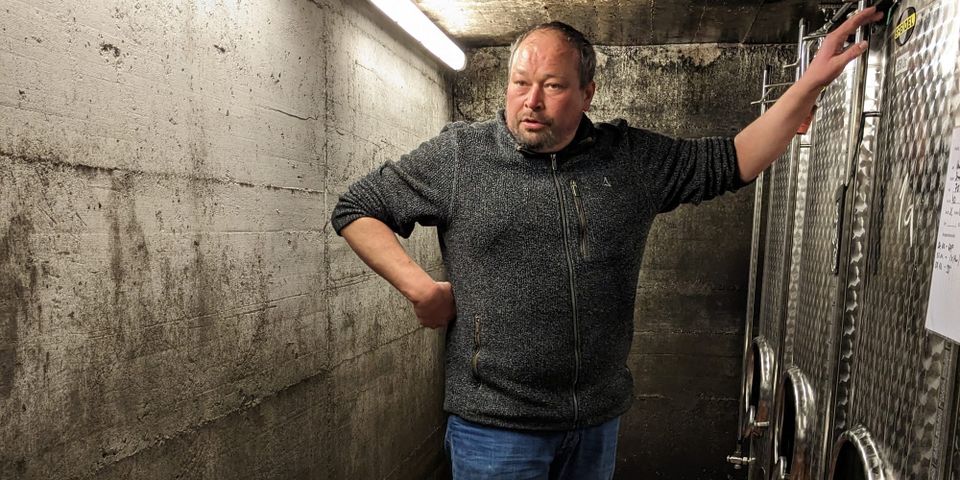
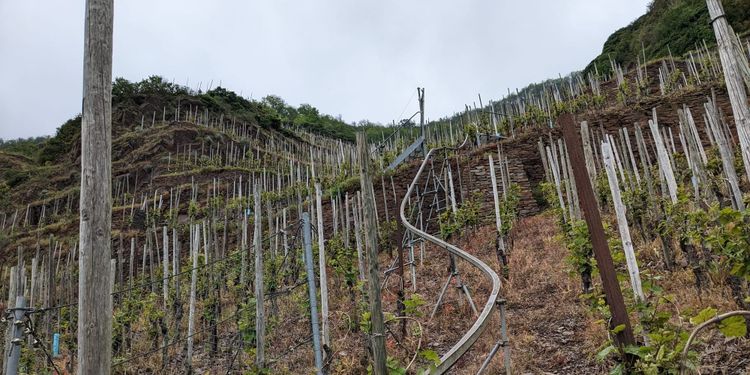
Falkenstein lies in the Konzer Tälchen ("the little valley of Konz), which, as I write this in February 2026, is a section of the Saar I've yet to visit, but home to the historic Krettnacher Euchariusberg, marked dark red on Franz Josef Clotten's 1868 Viticultural Map of the Saar and Mosel, indicating a high-value site in the eyes of the tax man. The Tälchen also comprises the steep slate sites of Krettnacher Altenberg (also dark red), Niedermenniger Herrenberg, and Niedermenniger Sonnenberg, all of which make up part of the 9-hectare estate owned by Erich Weber and cultivated by him and his sons.
Carlberg provides extensive detail about each of these sites and their Gewanne on his excellent larscarlberg.com, rendering anything I could add here futile. Carlberg is the source for information on these wines, but to summarize the Falkenstein philosophy: vine age is 40-90 years, and 1 hectare is ungrafted. Farming is mainly organic, with Bordeaux mixture avoided to limit copper buildup in the soil. Harvest is by hand.
In the cellar, Weber describes his minimalist approach as "Kontrolliertes nichts tun" (controlled doing nothing), and all fermentations are by ambient yeasts, with the various parcels vinified separately in old oak Fuder. In the old Mosel tradition, Weber bottles each Fuder separately, resulting in multiple bottlings of the same site and Prädikat. AP numbers vary; the eighth number, now highlighted in bold on the label, is the cask number.
The focus is on trocken and feinherb wines, and Falkenstein is the style of Saar wine I very much enjoy drinking. Weber adheres to the Prädikat system and uses the Prädikat + trocken naming convention that he views as a historical link to the tradition of unchaptalized Saar Rieslings. This and Spätburgunder produced without ML are probably not philosophies I'd share with Weber, but who cares when there's so much to love about these individual and detailed traditional wines from the Saar.
Von Othegraven, VDP.Weingut
“Altenberg is as steep as the Matterhorn,” Gunter Jauch likes to say, adding that “it’s a 65% grade from the foot to the summit.” Von Othegraven is a leading winery of the Saar producing Riesling exclusively from grand cru sites of Devonian slate soils. Since 2010, the owner is Günther Jauch, the quizmaster, and host of “Wer Wird Millionar?”, the German version of “Who Wants to Be a Millionaire?” Jauch lives in Berlin with his wife Thea and might be viewed by some as an outsider, but the couple had the inside track when the previous owner, Dr. Heidi Kegel, Jauch’s relative, decided to sell. Günther Jauch, whose grandmother was born a von Othegraven, is now the seventh generation of his family to own the estate. Von Othegraven was a founding member of the Association of German Natural Wine Auctioneers, today’s Verband Deutscher Prädikatsweingüter (VDP), and has been producing benchmark Saar wines since the early 19th century. All of Von Othegraven’s vineyards are VDP.Grosse Lage (grand cru). Typical of the Saar, they are incredibly steep, south-facing, and feature Devonian slate intermixed with Rotliegend (iron-infused slate). The signature site of Von Othegraven is the Kanzemer Altenberg, a vineyard you cannot miss when standing in the estate’s charming English garden. “Altenberg is as steep as the Matterhorn,” Jauch likes to say, adding that “it’s a 65% grade from the foot to the summit.” It is also the longest steep slope in Germany at 250 meters long. Steep and south-facing with slate and Rotliegend soil applies to the other grand crus of Wawerner Herrenberger (a Monopol) and Wiltinger Kupp. The vineyard that breaks the mold is the famous Ockfener Bockstein, one of the classic vineyards of the Saar, with silver-grey slate in a south-facing amphitheater. Even Riesling Max, the basic Gutswein Riesling of Von Othegraven, hails from the grand crus Altenberg and Herrenberg. Von Othegraven is one of the rare wineries to produce consistent quality despite several generations of family succession. Max von Othegraven took over the estate in 1921 and made a vintage for the ages that year. More recently, Jauch’s predecessor, Dr. Heidi Kegel, elevated the winery to new heights before turning over winemaking to Andreas Barth, then to the talented Sven Klinger in the summer of 2021. Under Sven’s direction, quality has soared, and Von Othegraven received Vinum Magazine’s German Winemaker of the Year award in 2023. the fermentation is spontaneous with natural yeasts, and he likes to give them the time they need to clarify and stabilize in stainless steel tanks and large neutral oak casks. Prädikatsweine and dry wines receive the same, unadulterated, very reduced treatment without the superfluous use of technology. The wines are bottled unfined.
Wwe Dr. H Thanisch - Erben Müller-Burggraef, Weingut
Wwe Dr. H Thanisch - Erben Thanisch , VDP.Weingut
Mosel: Winding Slopes of Slate →

Member discussion