Sekt in Germany
Germany consumes more sparkling wine than any other country. That's not per capita, although it often leads that statistic too; as a nation, Germany consumes around 400 million bottles, or 4.7 bottles per person, annually. Germany also produces a lot of sparkling wine: around 360 million bottles per year, making it the world's 3rd-largest sparkling wine-producing country, and 86% of it comes from seven companies. These Sektkellereien are large sparkling-wine bottlers that produce "Euroblends" of simple base wine, then turn it sparkling in industrial-scale German factories.
Check the cooler of any gas station along the Autobahn, and you'll find Pikkolos (200 ml*) of Rotkäppchen Sekt alongside the cans of Krombacher and Beck's. Discount grocers like Aldi and Lidl line their shelves with 3-6 euro Sekt, which accounts for 45% of German Sekt sales. Walk the streets of downtown Frankfurt at happy hour and notice what's in the glasses of business workers winding down at the sidewalk cafés. Sekt is everywhere in Germany; most of it is inexpensive and of dubious quality, but it wasn't always this way.
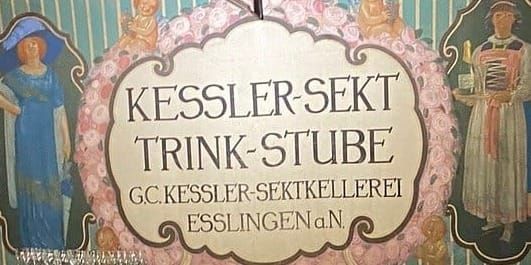
Early records suggest sparkling wine in Germany dates to the 18th century. Strong merchant ties between Champagne and Germany led many Germans to work in Champagne, where they founded famous houses like Bollinger, Deutz, Heidsieck, Krug, Mumm, and Roederer. The Napoleonic Wars (1803–1815) prompted many German wine professionals to return home. By 1826, Georg Christian Kessler (former directeur commercial of Veuve Clicquot) founded G.C. Kessler & Co. in Württemberg, establishing Germany's first dedicated sparkling wine house. Prominent Sektkellereien like Deinhard and Henkell were also founded in the 19th century.
German Sekt gained popularity in the late 19th and early 20th centuries, leading to explosive growth: 1.5 million bottles in 1850, 8 million in 1895, and 12 million by 1911. Otto Henkell, having studied commercial practices abroad, including time in London, and running the Henkell sales agency in New York for nine months, returned to Germany at age 23 with an understanding of American mass marketing. He released Henkell Trocken in 1894, registered it as a trademark in 1898, and invested heavily in advertising, commissioning renowned artists to create the classic illustrated advertisements still seen today.
Kaiser Wilhelm II introduced the Sekt Tax in 1902 to finance the imperial navy, establishing a tax mechanism that persists today (€1.02 per bottle). Two world wars and post-WWII economic pressures led to cost-cutting, and by the 1950s, the Sektkellereien increasingly relied upon the transfer method and imported bulk base wine. The transfer method lets wine undergo secondary fermentation in individual glass bottles while bypassing the expensive, time-consuming steps of individual riddling and disgorging. After second fermentation in the bottle, wines are disgorged into pressurized tanks and clarified en masse.
Before the reforms of the 1970s, the Sektkellereien held a monopoly over the commercial production and bottling of German Sekt. Independent winegrowers (Winzer) and small cooperatives were barred from producing sparkling wine from their own estate-grown fruit. German wine and tax statutes in the 20th century treated sparkling wine not as an agricultural product, but as an industrial consumer good, requiring strict licensing. To manufacture Sekt, a facility had to register as a Sektkellerei, meet onerous, factory-scale regulatory standards, and maintain dedicated bond facilities to collect the imperial sparkling wine tax (Schaumweinsteuer).
Individual wine estates that wanted to produce sparkling wine from their own grapes using the Traditional Method were legally prohibited from bottling, labeling, or marketing the product as Sekt until a 1976 legal decree abolishing the Sektkellereien monopoly. The reform provided the legal framework for Winzersekt to emerge. While the 1976 reform legalized Winzersekt, small estates could not afford the specialized machinery required for traditional method production—such as neck-freezing baths, automated disgorging machines, dosage dosers, muselets (wire cages), and high-pressure corkers—a problem Volker Raumland set out to solve.
Volker Raumland grew up in a winemaking family in the Pfalz and studied viticulture and enology at Geisenheim University in the early 1980s. While at Geisenheim, he conducted an experiment using 100 liters of 1981 Müller-Thurgau from his family's cellar and made sparkling wine using traditional in-bottle secondary fermentation. Months later, his bottle won a student blind tasting that included commercial Champagnes and Cavas. The experiment convinced him to dedicate his career to traditional method sparkling wine, and by 1984, he produced his first official commercial batch using his family's fruit.
Lacking the capital to purchase his own vineyards and winery facilities, Raumland capitalized on a major market need. He outfitted a mobile sparkling wine processing facility. He traveled from village to village, contracting to help small vintners turn their base wines into sparkling wines directly at their cellars. He handled everything from the initial tirage bottling to the riddling, disgorging, and dosage. Earnings from the contract business provided the capital to transition to a full-time sparkling wine producer. In 1990, Volker and his wife, Heide-Rose, purchased a property in Flörsheim-Dalsheim in Rheinhessen, with 4 hectares of vineyards.
Sekthaus Raumland would become recognized as Germany's benchmark sparkling wine producer and the first sparkling-only producer admitted to the prestigious VDP in 2020. Now a certified organic estate with 11.70 hectares and high-value sites such as Kirchenstück in Hohen-Sülzen, Frauenberg in Nieder-Flörsheim, and Bürgel in Flörsheim-Dalsheim, all classified as VDP.Große Lagen. Raumland enforces a self-imposed en tirage minimum of 36 months for entry-level cuvées, and 10 to 15+ years for Triumvirat Grande Cuvée before disgorgement. This lets Raumland buffer Germany's naturally high acidity with time rather than sugar. Almost all cuvées finish as Brut Nature with zero dosage or Extra Brut with under 3 g/L of residual sugar.
Raumland's philosophy has helped shape the quality standards for all premium German sparkling wine. The VDP created its VDP.Sekt quality charter in 2020, naming Volker Raumland as the commission's chairperson, and codified his philosophy into its statute. The VDP requires a minimum of 15 months on the lees for the VDP.Sekt category, while VDP.Sekt Prestige mandates at least 36 months, mirroring the aging regimes Raumland pioneered decades earlier.
Today, Raumland's future lies increasingly with his daughters Marie-Luise and Katharina, whose names bear the entry-level cuvées, if we can call them that. Cuvée Katharina Brut Nature is made from Pinot Noir and Pinot Meunier, while Cuvée Marie-Luise Brut is 100% Pinot Noir. The portfolio also includes Riesling Sekt, the most Germanic sparkling wine, plus unique expressions from the single sites mentioned above. Triumvirat Grande Cuvée is the tête de cuvée with remarkably long lees aging.
A second dedicated Sekt house joined the VDP in 2025: Sektgut Reinecker from Markgräflerland in Baden, and top Winzersekt has been emerging from all over Germany, including the number of sparkling wine projects Mathieu Kauffmann has touched since he arrived at Reichsrat von Buhl in 2013. Kaufmann began an ambitious Sekt project with Steffen and Sophie Christmann in 2019, and became technical director at the historic Weingut Karthäuserhof, the Mosel's Ruwer, in 2020. Karthäuserhof debuted its first-ever sparkling wine, the Karthäuserhof Brut, in autumn 2024, since the winery's monastic founding in 1335.
Sekthaus Griesel & Compagnie, from the often-forgotten region of Hessische Bergstraße, has made a serious contribution to Germany's sparkling wine renaissance. The Streit family founded Griesel in 2013 and hired a young, talented cellar master, Niko Brandner. Griesel champions the granite, quartz porphyry, and loess of Hessische Bergstraße, producing parcel-specific Sekt and micro-terroir bottlings like their Granite Parcellaire series. A tasting with Niko at their cellars in Bensheim will make any doubter a believer in what German Sekt can be.
Unlike the geographically protected name Champagne, Sekt is a catch-all term used for sparkling wine in Germany. Without the qualifier "Deutscher," plainly labeled Sekt is usually made from imported bulk base wines, produced via the Charmat (tank) or transfer method. Deutscher Sekt at least tells us that 100% of the grapes were harvested in Germany, though multi-regional blending is permitted. Sekt b.A. is Sekt sourced from one of Germany's 13 Weinanbaugebiete (winegrowing regions), whereby at least 85% of the grapes come from the specified region, and the vintage or variety may be indicated on the label. At this level, Sekt is subject to mandatory sensory evaluation and official testing to obtain an A.P. Number, but this still tells us little about production quality.
Winzersekt is defined as high-quality, estate-bottled varietal sparkling wine from 100% estate-grown grapes, produced exclusively via the classic traditional method (traditionelle Flaschengärung), with mandatory labeling of vintage and producer name. Winzersekt must spend at least 9 months en tirage before disgorgement. In 2009, German Wine Law introduced a rather odd category, Crémant, a legally protected designation reserved exclusively for premium Sekt b.A. that adheres to strict viticultural and winemaking standards modeled after Champagne. As in France, Crémant must be paired with the name of its winegrowing region (e.g., Crémant Baden, Crémant Pfalz, etc.) and follows the same guidelines as its French counterparts. If it's a differentiator in the German market, it has had little impact in export markets like the US.
*An authentic German Pikkolo is 200 ml, invented and trademarked by Henkell in 1935. The International "Piccolo" or Split (187 ml / 187.5 ml) is required for certain export markets—particularly in the US, UK, and Australia. Consequently, even European producers like Henkell package 187 ml versions for export to the US while continuing to sell 200 ml bottles domestically.
Member discussion